
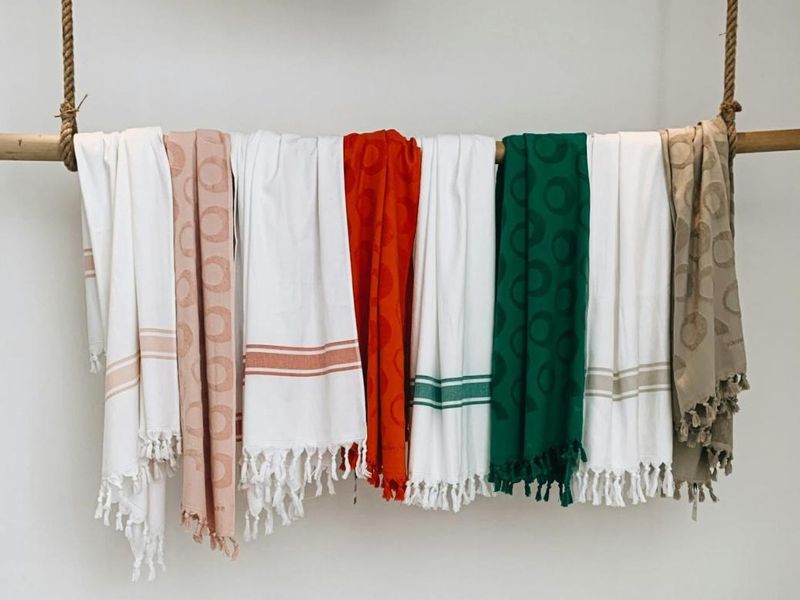
What exactly is a Turkish towel?
In its original sense, a Turkish towel is a peshtemal, a flat woven rectangle of cotton, sometimes mixed with linen, bamboo or silk, with twisted fringes at each end. It was made to be wrapped around the body in the hammam, the Turkish bath, where bathers move between warm rooms, hot marble and cool washing basins. It had to be light enough to wear, quick to dry in a steamy room, and modest enough to cover the body.
Today the same towel is used far beyond the bath. People take peshtemals to the beach, the pool and the gym, use them as bath towels at home, throw them over sofas, wear them as wraps and scarves, and pack them for travel. Hotels, spas and beach clubs give them to guests, and shops sell them in hundreds of colors and patterns.
The phrase Turkish towel is also used in a second, looser way. Many people say Turkish towel when they mean a terry bath towel made from Turkish cotton. Both meanings are common, and both point to the same country, so it helps to be clear which one you mean when you buy.
What does peshtemal mean?
Peshtemal, spelled peştamal in Turkish, is the traditional name for the hammam wrap. The word has been used for centuries for a cloth worn around the waist or body. In shops and catalogs you will also see hammam towel, Turkish bath towel, Turkish beach towel and fouta, a word used in North Africa for a similar cloth. They describe the same family of flat woven towels.
The traditional peshtemal is usually around one meter wide and one and a half to two meters long, which lets it wrap the body comfortably. Modern versions come in many sizes, from small hand towels to large blankets.
How is a Turkish towel different from a terry towel?
The difference is in the weave. A terry towel has loops of yarn standing up from a woven base on both sides. Those loops hold water and give terry its thick, soft feel. A peshtemal has no loops. It is a flat cloth, woven in a plain, herringbone, diamond or striped pattern, much like a light blanket or a thick shirt fabric.
| Feature | Peshtemal Turkish towel | Terry towel |
|---|---|---|
| Weave | Flat weave, no loops | Looped pile on both sides |
| Typical weight | About 180 to 280 gsm | About 350 to 750 gsm |
| Thickness | Thin and light | Thick and plush |
| Drying time | Very fast | Slower, especially heavy towels |
| Packing size | Folds very small | Bulky |
| Feel when new | Crisp, softens with washing | Soft from the start |
| Ends | Hand knotted or twisted fringes | Hemmed |
Neither is better in every way. A peshtemal is ideal where weight, space and drying time matter. A terry towel is ideal where thickness and a plush feel matter most. Many buyers stock both.
Are Turkish towels good?
Yes, for the right uses they are excellent. A well made peshtemal absorbs a surprising amount of water for its weight, dries in a fraction of the time a terry towel takes, packs down to almost nothing and lasts for years. It also gets softer and more absorbent with each wash, which is the opposite of what many cheap towels do.
They are not right for everyone. Someone who loves the feeling of wrapping up in a thick, heavy towel after a bath may find a peshtemal too thin. For them, a terry towel made from Turkish cotton is the better choice. For beach days, travel, gyms, spas, small bathrooms and humid climates, many people never go back once they try a peshtemal.
Quality varies widely. A good Turkish towel is woven from good cotton yarn, with an even, tight weave, neat selvedges and firmly knotted fringes. A poor one is thin, loose, rough and quick to fray. The checks later in this guide help you tell them apart.
Is Turkish cotton good for towels?
Turkish cotton is one of the best cottons for towels. It is a long staple cotton, which means its fibers are longer than those of ordinary cotton. Longer fibers make stronger, smoother yarns with less lint, and towels made from them absorb well, last longer and feel softer.
Turkish cotton has a particular quality that suits both peshtemals and terry towels: it absorbs well and dries quickly. It is less dense than extra long staple cottons, so water moves in and out of the yarn easily. That is why Turkish cotton towels are prized in hotels and spas, where towels must dry quickly between uses. Our guide comparing Turkish and Egyptian cotton towels explains the differences in detail.
How are Turkish towels made?
A peshtemal starts as cotton yarn. Many Turkish towels use yarn dyed in advance, because the stripes and patterns of a peshtemal are woven in rather than printed. The colored yarns are wound onto a warp beam in the order the design needs, and the loom weaves the weft across them.
Traditional peshtemals were woven on hand looms, and some still are in towns known for weaving. Most peshtemals sold today are woven on modern shuttle or rapier looms, which can produce the same patterns faster and more evenly. Weave patterns such as herringbone, diamond and honeycomb are created by the way the loom lifts the warp threads.
Once woven, the cloth is cut to length, and the loose warp threads at each end are twisted or knotted into fringes. This is often done by hand, and good fringe work is a sign of a carefully made towel. The towels are then washed, which softens them and sets the size, dried, inspected, folded and packed.
Which weave patterns are common?
Peshtemals come in many traditional and modern weaves. Each has its own look and feel.
- Plain weave with stripes, the classic hammam look, often in two or three colors along the length.
- Herringbone, a zigzag weave that gives texture and a slightly thicker feel.
- Diamond, a small repeating diamond pattern that catches the light.
- Honeycomb or waffle, with raised cells that make the towel more absorbent and textured.
- Chevron and checks, used for bolder, more decorative towels.
- Pestemal with a terry back, a hybrid that has a flat face and a looped back for extra absorbency.
Some ranges add metallic threads, tassels, pompoms or embroidered borders. Others use undyed natural cotton for a raw, simple look.
What sizes do Turkish towels come in?
There is no fixed standard, but most peshtemal makers use a similar set of sizes.
| Type | Typical size | Common use |
|---|---|---|
| Hand towel | About 50 x 90 cm | Bathrooms, kitchens, guest towels |
| Bath or body towel | About 90 x 170 cm to 100 x 180 cm | Bath, hammam, beach, travel |
| Large beach towel | About 100 x 200 cm | Beach, pool, picnic |
| Throw or blanket | About 150 x 200 cm and larger | Sofas, beds, outdoor use |
Sizes are usually given without the fringes. If size matters for your packaging or display, ask whether the stated length includes them.
What is a Turkish beach towel?
A Turkish beach towel is simply a peshtemal used at the beach, and the beach is where many people first discover them. They are light to carry, take little space in a bag, dry quickly in the sun and shake free of sand far more easily than a terry towel. Wet, they can be worn as a wrap; dry, they become a blanket to lie on.
Resorts, beach clubs and hotels use them for guests, and gift and fashion shops sell them by the thousand each summer. For businesses buying in bulk, our Turkish beach towels wholesale page covers sizes, weaves and custom colors.
How absorbent is a flat woven towel?
More absorbent than most people expect. A peshtemal does not hold as much water as a heavy terry towel, but it absorbs quickly, and because it is large and thin, much of its surface is in contact with the skin. In practice, a full size peshtemal dries a body after a shower or a swim comfortably.
New peshtemals can feel less absorbent because the yarn is still tight and may carry a little finishing. After a few washes, the cotton fibers relax and open, and absorbency improves noticeably. That is why many makers pre wash their towels before packing, and why customers often say their Turkish towels get better with age.
Why do Turkish towels dry so fast?
Because there is very little cotton per square meter and no loops to trap water. Air moves through the thin cloth, and water evaporates from both sides at once. A peshtemal hung in the sun can dry in well under an hour, and even indoors it is usually dry long before a terry towel would be.
Fast drying has practical benefits beyond convenience. Towels that dry quickly are less likely to smell musty, which matters in humid climates and in gyms and spas. They need less energy in a dryer, which matters for hotels and laundries. And they are lighter to wash, ship and store.
Where are Turkish towels used in business?
Peshtemals have become a staple product for many kinds of businesses.
- Hotels and resorts use them as beach and pool towels and in hammam and spa areas.
- Spas and wellness centers give them to clients for treatments and steam rooms.
- Beach clubs and holiday rental companies supply them to guests.
- Gyms and yoga studios use them because they are light and fast drying.
- Gift shops, fashion boutiques and home stores sell them as lifestyle products.
- Online brands sell them under their own label, often in curated color collections.
- Companies use them as promotional gifts with woven or printed logos.
Because peshtemals are light, a large quantity ships at modest cost, which helps online sellers and distributors keep their margins.
Can Turkish towels be customized?
Yes, in many ways. Colors and stripe layouts can be designed for your brand, as long as the order reaches the minimum quantity for each design and color. Logos can be woven into the towel, embroidered on a corner or border, or printed. Labels, hang tags, bands and packaging can carry your brand. Fringe styles, sizes and weaves can be chosen to suit your range.
For woven designs, the minimum quantity depends on the loom setup and the yarn colors, so it helps to plan a few colorways at once. For embroidery and labels, smaller runs are possible on stock colors. Our Turkish towels wholesale program explains the options and minimums.
How do you tell a good Turkish towel from a poor one?
Several simple checks separate quality peshtemals from cheap imitations.
- Hold the towel up to the light. A good one has an even, close weave with no thin patches.
- Feel the weight. A full size peshtemal should feel substantial for its thinness, not papery.
- Check the selvedges, the long side edges. They should be straight and firm, not loose or wavy.
- Check the fringes. They should be evenly twisted or knotted and not unravel when tugged.
- Read the label. It should name the fiber, ideally 100 percent cotton or a stated blend.
- Wash it. A good peshtemal softens and keeps its shape; a poor one shrinks unevenly, bleeds color or frays.
Many cheap towels sold as Turkish are woven elsewhere from short staple or synthetic yarn. If origin matters to your customers, ask your supplier where the towels were woven and keep the documents.
How should Turkish towels be washed?
Peshtemals are easy to care for. Wash them before first use, ideally two or three times, to soften the cotton and increase absorbency. Wash colored towels separately at first in case of loose dye. Use a normal detergent and avoid fabric softener, which coats the fibers. Line drying is ideal; tumble drying on low heat is fine. Iron if you like a crisp look, though most people prefer the natural crinkled texture.
Fringes can tangle in the wash. Washing peshtemals in a laundry bag or on a gentle cycle helps, and a quick shake when wet straightens them. Over time, the cotton becomes softer, more drapey and more absorbent.
Are Turkish towels sustainable?
They can be one of the lower impact towel choices. A peshtemal uses far less cotton than a terry towel of the same size, so less fiber, water and energy go into making it. It dries faster, needs less energy in the dryer, and lasts for years. Organic cotton peshtemals take this further, and Turkey is a significant producer of organic cotton.
Undyed or naturally colored versions avoid dyeing altogether. Recycled cotton blends are also possible. If sustainability is part of your brand, ask for organic certification documents and say which claims you plan to make on your labels.
Why are the best Turkish towels made in Turkey?
The peshtemal was born in Turkey, and the country still has the deepest knowledge of how to weave, finish and fringe it. Weaving towns in the Aegean and Denizli regions have made hammam textiles for generations, and that skill has passed into modern mills with fast looms and large dye houses.
Turkey also grows its own cotton, spins its own yarn and dyes and finishes cloth locally. That short chain means good control of quality and color, quick sampling and fast delivery, especially to Europe and the Middle East. Peshtemals woven elsewhere can look similar in photos, but buyers who handle them side by side usually notice the difference in weave, weight and finish. Our towel manufacturer in Turkey page explains how we produce them.
What is the history of the Turkish towel?
Public baths were part of daily life in Anatolia long before the Ottoman era, and the hammam became a central social space in Ottoman cities. People went to the hammam to wash, relax, meet friends and mark important moments such as weddings and births. Every visit needed cloth: a wrap for the body, a towel for drying, sometimes a cloth for the head. The peshtemal filled that role.
Weaving centers grew up to supply them. Towns in western Anatolia became known for fine cotton and linen cloth, and peshtemals were woven in family workshops and traded across the region. Patterns, colors and borders varied by town and by status; a bride's hammam set could be richly decorated, while everyday towels were plain and practical.
Terry towels arrived later, in the nineteenth and twentieth centuries, as looped weaving spread. Turkish weavers took up terry quickly, and the country grew into a major producer of looped towels too. In recent decades the peshtemal has had a second life as a fashionable beach and home product, first in Mediterranean resorts and then in shops around the world.
Which fibers are used besides cotton?
Most peshtemals are 100 percent cotton, which gives the best balance of absorbency, softness, price and easy care. Blends are used to change the look and feel.
| Fiber or blend | Effect on the towel |
|---|---|
| 100 percent cotton | Soft, absorbent, easy to wash, the standard choice |
| Organic cotton | The same feel, grown and processed under organic rules |
| Cotton and linen | Crisper, lint free, faster drying, with a natural texture |
| Cotton and bamboo viscose | Silkier and cooler to the touch, with more drape |
| Cotton with metallic yarn | Decorative shine in stripes or borders |
| Recycled cotton blends | Lower virgin fiber use, slightly more rustic feel |
Silk and fine linen peshtemals also exist at the luxury end, mostly as wraps and scarves rather than working towels.
How do Turkish towels compare with foutas, sarongs and kikoys?
Several flat cloths from around the world look similar to a peshtemal. The fouta comes from North Africa and is very close in construction, often with bold stripes. The sarong, worn across South and Southeast Asia, is usually a lighter printed fabric meant for wearing rather than drying. The kikoy, from East Africa, is a striped cotton cloth with fringes, used as a wrap and a towel.
What sets the peshtemal apart is its focus on being a towel first. It is woven to absorb water and stand up to frequent washing, with a weight and weave chosen for drying the body. Sarongs and many printed wraps are thinner and less absorbent. When customers ask for a beach towel that doubles as a wrap, the peshtemal is usually the best answer.
Which colors and designs sell best?
Tastes change by market and season, but a few patterns hold steady. Classic stripes in navy, white, sand and terracotta sell year after year because they suit beaches, bathrooms and homes. Soft neutrals such as stone, sage, oat and dusty pink work well for home and spa ranges. Bright, bold stripes and checks do well in beach and resort shops. Undyed natural cotton appeals to brands with a simple, natural look.
Retailers often build a core collection of six to ten colors that stay in the range, then add two or three seasonal colors each year. That keeps reorders simple while giving shoppers something new. Hotels and spas usually pick one or two colors that match their interiors and reorder them unchanged for years.
Can Turkish towels replace terry towels in hotels?
In some areas, yes. Many resort hotels now use peshtemals at the pool and beach, in hammams, saunas and steam rooms, and as part of spa treatments. They are light for staff to carry, quick to launder and dry, and guests like them. Boutique hotels with a Mediterranean or natural style sometimes place them in bathrooms alongside terry towels as a second option.
In most guest bathrooms, terry towels remain the main choice, because guests expect a thick bath towel after a shower. A practical approach is terry in the bathroom and peshtemals everywhere else, which cuts laundry weight across the property without changing what guests expect in their rooms.
How are Turkish towels priced in bulk?
Several factors decide the price per piece of a peshtemal. Size and weight come first, because they set how much yarn goes into each towel. The fiber matters next: organic cotton, linen and bamboo blends cost more than conventional cotton. Yarn dyed stripes and complex weaves such as diamond and herringbone take more loom setup than plain weaves. Hand knotted fringes cost more than machine twisted ones. Pre washing, custom labels, logos and retail packaging all add to the cost.
Quantity has a strong effect too. Setting up a loom for a new color layout takes time, so larger runs spread that cost across more towels. If you are building a range, choosing a few designs in larger quantities is usually more efficient than many designs in small runs. A quotation for two or three options side by side shows where the price breaks are.
How are Turkish towels packed and shipped?
Peshtemals are light and pack flat, which makes them cheap to ship compared with terry towels. A typical full size peshtemal weighs a few hundred grams, so a carton holds many pieces. For retail, towels can be folded or rolled and finished with a paper band, a ribbon, a hang tag or a box. For hotels and spas, they are usually packed flat in polybags of ten or twenty.
Because volumes are low, peshtemal orders often travel by road or air at reasonable cost, which helps brands that need fast replenishment in the summer season. Larger orders go by sea in shared or full containers.
Should your business sell or use Turkish towels?
If your customers or guests spend time at the beach or pool, travel, use spas or gyms, or like simple, natural home products, peshtemals are worth adding. They are light to ship, easy to display, available in many designs and well liked by end users. They work well as a companion to terry towels rather than a replacement, so many businesses offer both.
If you are starting a new towel line, peshtemals can be an easy first product because they ship cheaply, sell well online and are simple to customize with color and labels. Our guide on how to start a towel business covers the steps from idea to first order.
What should you ask a Turkish towel supplier?
Before ordering, ask a few direct questions. Where are the towels woven? What fiber and yarn are used? What is the weight in gsm and the size with and without fringes? Are the towels pre washed? What is the minimum per color and design? How are the fringes made? Which documents and standards apply? How long do samples and bulk production take?
It also helps to ask how colors are matched between orders, how long the supplier keeps your designs on file, and whether the same loom and yarn will be used for reorders. Those answers tell you whether next summer's towels will match this summer's.
A serious manufacturer will answer clearly and send samples of the exact towel you would buy. Compare samples side by side, wash them, and choose on the evidence. When you are ready, send us your brief and we will reply with a quotation and samples.